


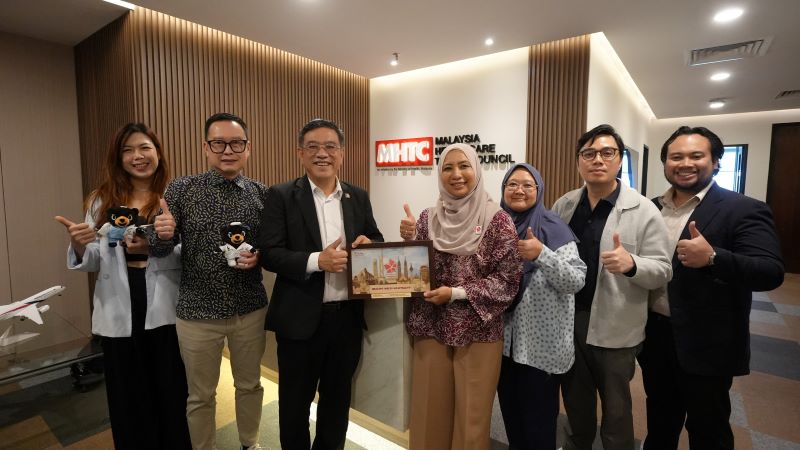
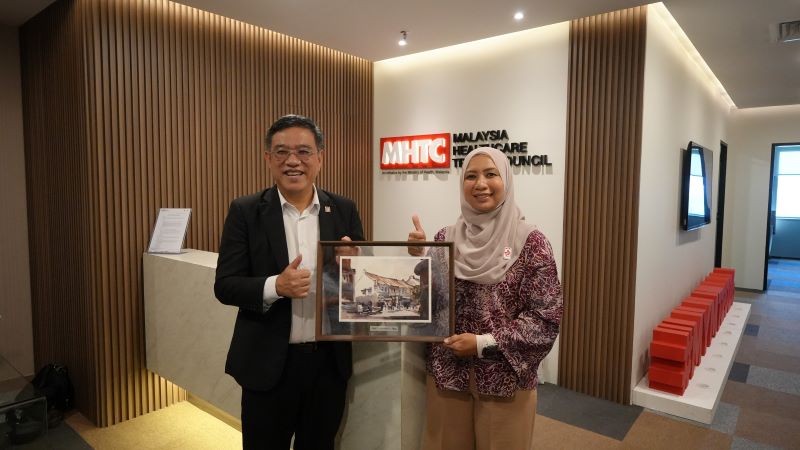
This year is not only Visit Malaysia Year 2026, but also Malaysia Year of Medical Tourism 2026 (MYMT 2026). As the year enters its final quarter, Penang State Executive Councillor for Tourism and Creative Economy Wong Hon Wai recently has meet the Malaysia Healthcare Travel Council (MHTC) in Kuala Lumpur, reviewing the performance data medical tourism of Penang and gaining a deeper understanding of Penang’s position within Malaysia’s medical tourism landscape.
The meeting also focused on the strategic direction, resource coordination and joint promotional efforts for the final quarter of 2026, with both sides discussing ways to better align federal and state-level promotional resources and ensure that national-level resources are channelled more effectively into Penang’s medical tourism ecosystem, maximising the impact of resource integration and collaborative promotion.
“According to the MHTC, Penang welcomed approximately 520,000 medical tourists in 2025, generating RM1.14 billion in medical tourism revenue, reflecting strong performance.”
“This growth momentum has continued into 2026. According to data from the MHTC, Penang welcomed approximately 285,400 medical tourists in the first half of 2026, generating RM601.8 million in medical tourism revenue. This demonstrates that Penang’s medical tourism market has reached significant scale and continues to play an important role in Malaysia’s medical tourism industry.”
“It is important to note that these figures only cover hospitals but do not include dental clinics, clinical laboratories, diagnostic centres, pharmacies and other related healthcare service providers. Therefore, when the medical tourism ecosystem is viewed in its entirety, the actual number of medical tourists served by Penang and the economic activities generated are likely to be even more significant,” Wong said.
“Whether measured by the number of medical tourism or the economic contribution generated by medical tourists, Penang accounts for more than one-third of Malaysia’s medical tourism industry and remains the country’s leading destination. This clearly demonstrates Penang’s significant position within Malaysia’s medical tourism landscape.”
“It is worth highlighting that Malaysia was recently ranked sixth globally in Travel And Tour World’s ‘Top 50 Best Medical Tourism Destinations in the World for 2026’, placing Malaysia among the leading destinations in Asia. As Malaysia’s leading medical tourism state, Penang’s engagement with the MHTC is aimed at capitalising on Malaysia’s global recognition and building on this momentum to further expand Penang’s international medical tourism market.”
“While price is certainly one of Penang’s attractions for medical tourists, it is by no means our only advantage. Penang’s medical tourism industry has several core strengths, including multiple internationally accredited healthcare institutions, modern medical facilities and equipment, competitively priced and high-quality healthcare services, as well as multilingual capabilities and a conducive communication environment. Coupled with the Penang State Government’s proactive efforts to promote medical tourism and further strengthen the supporting ecosystem and infrastructure, these advantages complement one another and have helped establish Penang as one of Asia’s competitive medical tourism destinations.”
“Indonesia has long remained Penang’s largest source market for medical tourism. Penang currently has direct flight connections from major Indonesian cities including Jakarta, Surabaya, Banda Aceh and Medan, while a new direct flight route between Batam and Penang is set to commence on 18 October 2026. The continued expansion of these air links reflects Penang’s efforts to strengthen its aviation network, enhance connectivity between Penang and major cities in Indonesia, and further consolidate and expand the Indonesian medical tourism market,” Wong added.
“In recent years, neighbouring countries such as Vietnam, Thailand and Pakistan have also begun actively developing medical tourism industry, resulting in increasingly intense regional competition. Penang must therefore remain forward-looking and plan ahead. Compared with other medical tourism destinations in the region, Malaysia has the advantage of multilingual communication, which forms an important foundation for Penang to diversify its international source markets. Malay enables us to deepen our reach into Indonesia and other Southeast Asian markets, English facilitates engagement with medical tourists from Western countries, while Chinese-language capabilities allow us to further serve the Greater China market. Therefore, Penang will not be content with relying solely on the Indonesian market, but will continue to pursue excellence by consolidating traditional source markets while identifying and developing a more diverse range of potential international markets.” he said.
“In terms of diversifying international source markets, the Arab region is a potential medical tourism market that Penang should explore further. Some Arab medical tourists are currently choosing Thailand as a medical tourism destination. Penang’s strengths, including quality healthcare services, competitive pricing and comprehensive Muslim-friendly tourism resources, are well aligned with the needs of Muslim travellers from the Arab region. We should therefore study the market’s needs more closely and actively seek to attract this potential group of medical tourists.”
“Beyond the Middle East, Australia is another potential source market worth exploring. For Australian travellers, Penang’s beaches, food, heritage sites and rich cultural heritage are highly attractive. These tourism assets appeal not only to conventional tourists, but are also important considerations for medical tourists when choosing a destination. While Australia has a well-developed healthcare system, certain medical services may involve longer waiting times and higher costs. By comparison, Malaysia’s favourable exchange rate enables us to offer competitively priced, high-quality healthcare services. Together with relatively convenient appointment and service processes for certain medical procedures, Penang is well positioned to attract more Australian travellers seeking healthcare services, while allowing them to extend their stay and enjoy Penang’s tourism offerings.”
“Health screening is one example. Penang’s advantage lies in its ability to provide a one-stop healthcare experience, where travellers can undergo multiple examinations at the same healthcare institution and obtain their results within a relatively short period. Some health screening packages can even be completed with the report issued on the same day. In comparison, under certain overseas healthcare systems, patients may need to visit different medical centres for different examinations and wait several days or even longer to complete the entire process. For international medical tourists, time and service convenience are just as important as price when making their decisions,” Wong added.
He also took the opportunity to gain a deeper understanding from the MHTC of the healthcare needs and preferred medical services of different source markets, in order to better understand the characteristics and different preferences of each market. He said: “This will enable the Penang State Government, when conducting tourism promotions overseas, to tailor our approach to the healthcare needs of individual source markets, promoting healthcare services in Penang that match their specific needs, precisely targeting potential travellers and further directing international medical tourists to Penang.”
Also present at the meeting with the MHTC were Ooi Chok Yan (Chief Executive Officer of Penang Global Tourism), Pauline Yoon (Senior Manager of Penang Global Tourism); Muhammad Iqbal Ilmi Ab Razak (Strategic Planning Senior Executive of the MHTC), Aida Idris (Vice President of Data Analytics and Strategy of MHTC), Marleena Ahmad Rapiee, (Data Analytics Manager of MHTC) and Rahmatullah Baragau (Senior Manager of Indonesia Market Marketing of MHTC).