


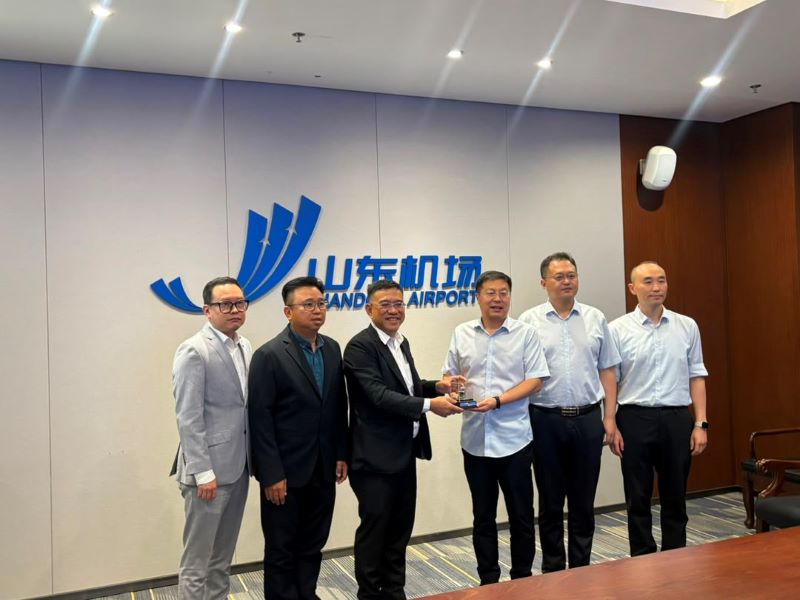
Penang State Exco for Tourism and Creative Economy, YB Wong Hon Wai, recently led a Penang State Government delegation to Shandong, China, for a tourism promotion and aviation networking visit.
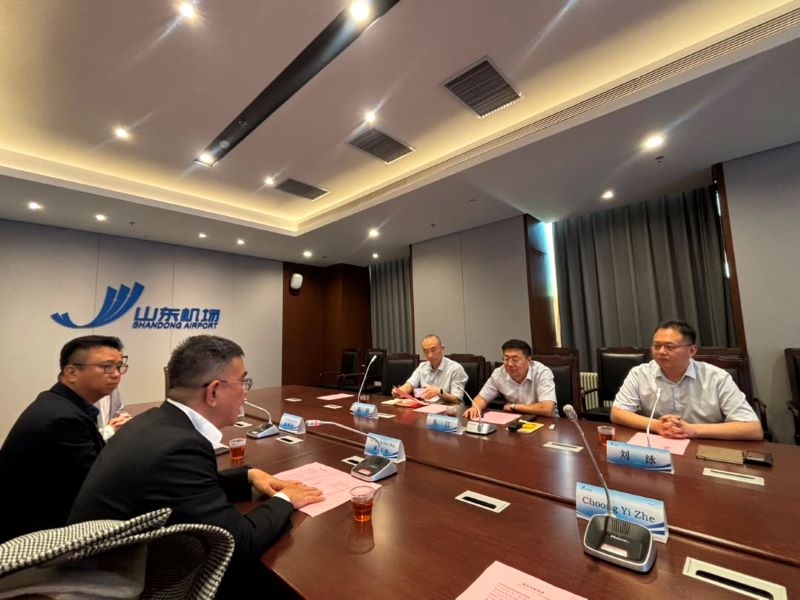
Apart from travelling to Qingdao to host the Penang – Qingdao Tourism roadshow, which aimed to promote Penang’s diverse tourism offerings, rich cultural heritage and unique destination appeal to the Shandong market, the delegation also paid a visit to Jinan Yaoqiang International Airport, where they met with the management of Jinan Yaoqiang International Airport to exchange views on strengthening air connectivity and regional tourism cooperation.
During the meeting, Wong and the Jinan International Airport team held in-depth discussions on the feasibility of establishing a direct Jinan–Penang flight.
Wong said Shandong is one of China’s major provinces in terms of population and economic strength, with a vast tourism catchment and considerable market potential.
“Shandong is one of China’s major provinces, while Jinan has a permanent population of over 9.6 million, underscoring its considerable market potential.” he said.
Wong added that the Qingdao–Penang direct flight, which was officially launched on March 31, 2026, had laid a strong foundation for Penang to tap into Shandong and the wider northern China tourism market.
“However, if Penang is to further deepen its presence in the Shandong market, maximise the vast population dividend of Shandong Province and unlock greater tourism consumption potential, we must continue to build on the current momentum and take our aviation network development to the next level,” he said.
Wong said that Jinan, as the capital of Shandong Province, is located in central Shandong and is well connected to surrounding cities such as Dezhou, Binzhou, Zibo, Tai’an and Liaocheng. Qingdao, meanwhile, is situated in the southern part of the Shandong Peninsula, facing the Yellow Sea and neighbouring Yantai, Weifang and Rizhao.
“The two cities, one in the east and the other in the central part of Shandong, each possess distinct locational advantages. If Penang is able to explore the possibility of a direct Jinan–Penang flight in addition to the existing Qingdao route, it will help Penang establish a more comprehensive and multi-dimensional aviation network in Shandong,” he said.
He added that with China’s extensive and highly efficient high-speed rail network, travellers from various parts of Shandong could conveniently connect by rail to either Jinan or Qingdao Airport, before taking a direct flight to Penang.
“In other words, if Penang can position both Qingdao and Jinan as two key gateways in Shandong, it will further enhance the accessibility and convenience for Shandong travellers to visit Penang. At the same time, it will strengthen Penang’s visibility and appeal in the northern China market, opening up an even broader source market for Penang’s tourism industry,” he said.
Wong further said Penang has made steady and visible progress in expanding its air connectivity with China in recent years.
“Looking back to August 2023, when I first assumed office, Penang had scheduled direct flights to only two Chinese cities, namely Guangzhou and Hong Kong. Through the Penang State Government’s sustained and proactive efforts, Penang is now connected by scheduled direct flights to 8 Chinese cities, namely Guangzhou, Xiamen, Hong Kong, Shanghai, Shenzhen, Chengdu, Qingdao and Chongqing,” he said.
He said that with the addition of charter flights between Kunming and Penang, Penang is currently connected to nine major China cities through direct air links.
“This reflects the growing recognition and demand from the China market for Penang’s tourism products, cultural heritage, culinary experiences and city appeal. Therefore, the Penang State Government hopes to build on this foundation and continue working towards securing more direct flights between China cities and Penang,” he said.
Wong also pointed out that Penang International Airport recorded 8,314,565 passenger movements in 2025, compared with 7,473,462 passenger movements in 2024, marking an increase of 11.25%.
“These figures clearly demonstrate that Penang’s appeal as an international tourism destination and regional aviation hub is continuing to grow steadily,” he said.
He also added that the expansion works at Penang International Airport is currently progressing and are expected to be completed in 2028. Upon completion, the airport’s annual passenger handling capacity will be increased to 12 million passengers, creating greater room for Penang’s future tourism development, international route expansion and regional economic growth.
Wong said the route discussions and market development efforts currently undertaken by the Penang State Government are part of its forward planning for the aviation landscape of Penang International Airport in year 2027 and 2028.
“Air connectivity is never built overnight. It requires early planning, continuous engagement and long-term cultivation. Our current efforts to engage with major Chinese cities, airport groups and airlines are aimed at ensuring that once the Penang International Airport expansion is completed, Penang will be ready with a stronger route network, a broader visitor base and more mature market preparation to welcome the next phase of growth in our tourism industry,” he said.
He cited the Penang State Government’s participation through Penang Global Tourism at Routes Asia Conference as an example of such forward planning.
Source – Penang Tourism Office